메인 콘텐츠로 건너뛰기
Weave _Leaderboards_를 사용하면 여러 메트릭에 걸쳐 여러 모델을 평가하고 비교하여 정확도, 생성 품질, 지연 시간 또는 맞춤형 평가 로직을 측정할 수 있습니다. 리더보드를 사용하면 한곳에서 모델 성능을 시각화하고, 시간에 따른 변화를 추적하며, 팀 전체 벤치마크에 대한 합의를 이끌어낼 수 있습니다. 리더보드는 다음과 같은 경우에 적합합니다.
  • 모델 성능 저하 추적
  • 공유 평가 워크플로 조율
리더보드 생성은 Weave UI와 Weave Python SDK에서만 지원됩니다. TypeScript 사용자는 Weave UI를 사용해 리더보드를 생성하고 관리할 수 있습니다.

리더보드 생성

Weave UI 또는 프로그래밍 방식으로 리더보드를 생성할 수 있습니다.

UI 사용

Weave UI에서 직접 리더보드를 만들고 사용자 지정하려면 다음과 같이 하세요.
  1. Weave UI에서 Leaders 섹션으로 이동합니다. 보이지 않으면 MoreLeaders를 클릭합니다.
  2. + New Leaderboard를 클릭합니다.
  3. Leaderboard Title 필드에 설명적인 이름(예: summarization-benchmark-v1)을 입력합니다.
  4. 필요에 따라 이 리더보드에서 무엇을 비교하는지 설명하는 내용을 추가합니다.
  5. 표시할 평가와 메트릭을 정의하려면 열 추가를 수행합니다.
  6. 레이아웃이 마음에 들면 리더보드를 저장하고 게시하여 다른 사람과 공유합니다.

열 추가

리더보드의 각 열은 특정 평가의 메트릭을 나타냅니다. 열을 설정하려면 다음을 지정합니다.
  • 평가: 드롭다운에서 평가 run을 선택합니다(미리 생성되어 있어야 함).
  • Scorer: 해당 평가에 사용된 채점 함수(예: jaccard_similarity, simple_accuracy)를 선택합니다.
  • 메트릭: 표시할 summary 메트릭(예: mean, true_fraction 등)을 선택합니다.
열을 더 추가하려면 Add Column을 클릭합니다. 열을 편집하려면 오른쪽의 액션 () 메뉴를 클릭합니다. 다음 작업을 할 수 있습니다.
  • 앞 / 뒤로 이동 – 열 순서를 변경합니다
  • 복제 – 열 정의를 복사합니다
  • 삭제 – 열을 제거합니다
  • 오름차순 정렬 – 리더보드의 기본 정렬을 설정합니다(다시 클릭하면 내림차순으로 전환됨)

Python

바로 실행할 수 있는 전체 코드 예제가 필요하신가요? 엔드투엔드 Python 예제를 참조하세요.
리더보드를 생성하고 게시하려면 다음과 같이 하세요.
  1. 테스트 데이터셋을 정의합니다. 기본 제공 Dataset을 사용하거나, 입력과 타깃 목록을 직접 정의할 수 있습니다:
    dataset = [
        {"input": "...", "target": "..."},
        ...
    ]
    
  2. 하나 이상의 scorers를 정의합니다:
    @weave.op
    def jaccard_similarity(target: str, output: str) -> float:
        ...
    
  3. Evaluation을 생성합니다:
    evaluation = weave.Evaluation(
        name="My Eval",
        dataset=dataset,
        scorers=[jaccard_similarity],
    )
    
  4. 평가할 모델을 정의합니다:
    @weave.op
    def my_model(input: str) -> str:
        ...
    
  5. 평가를 실행합니다:
     async def run_all():
         await evaluation.evaluate(model_vanilla)
         await evaluation.evaluate(model_humanlike)
         await evaluation.evaluate(model_messy)
    
    asyncio.run(run_all())
    
  6. 리더보드를 생성합니다:
    spec = leaderboard.Leaderboard(
        name="My Leaderboard",
        description="Evaluating models on X task",
        columns=[
            leaderboard.LeaderboardColumn(
                evaluation_object_ref=get_ref(evaluation).uri(),
                scorer_name="jaccard_similarity",
                summary_metric_path="mean",
            )
        ]
    )
    
  7. 리더보드를 게시합니다.
    weave.publish(spec)
    
  8. 결과를 조회합니다:
    results = leaderboard.get_leaderboard_results(spec, client)
    print(results)
    

End-to-End Python 예제

다음 예제에서는 Weave Evaluations를 사용해 맞춤형 메트릭으로 공유 데이터셋에서 세 가지 요약 모델을 비교하는 리더보드를 만듭니다. 작은 벤치마크를 만든 뒤 각 모델을 평가하고, Jaccard similarity로 각 모델의 점수를 매긴 다음, 결과를 Weave 리더보드에 게시합니다.
import weave
from weave.flow import leaderboard
from weave.trace.ref_util import get_ref
import asyncio

client = weave.init("leaderboard-demo")

dataset = [
    {
        "input": "Weave is a tool for building interactive LLM apps. It offers observability, trace inspection, and versioning.",
        "target": "Weave helps developers build and observe LLM applications."
    },
    {
        "input": "The OpenAI GPT-4o model can process text, audio, and vision inputs, making it a multimodal powerhouse.",
        "target": "GPT-4o is a multimodal model for text, audio, and images."
    },
    {
        "input": "The W&B team recently added native support for agents and evaluations in Weave.",
        "target": "W&B added agents and evals to Weave."
    }
]

@weave.op
def jaccard_similarity(target: str, output: str) -> float:
    target_tokens = set(target.lower().split())
    output_tokens = set(output.lower().split())
    intersection = len(target_tokens & output_tokens)
    union = len(target_tokens | output_tokens)
    return intersection / union if union else 0.0

evaluation = weave.Evaluation(
    name="Summarization Quality",
    dataset=dataset,
    scorers=[jaccard_similarity],
)

@weave.op
def model_vanilla(input: str) -> str:
    return input[:50]

@weave.op
def model_humanlike(input: str) -> str:
    if "Weave" in input:
        return "Weave helps developers build and observe LLM applications."
    elif "GPT-4o" in input:
        return "GPT-4o supports text, audio, and vision input."
    else:
        return "W&B added agent support to Weave."

@weave.op
def model_messy(input: str) -> str:
    return "Summarizer summarize models model input text LLMs."

async def run_all():
    await evaluation.evaluate(model_vanilla)
    await evaluation.evaluate(model_humanlike)
    await evaluation.evaluate(model_messy)

asyncio.run(run_all())

spec = leaderboard.Leaderboard(
    name="Summarization Model Comparison",
    description="Evaluate summarizer models using Jaccard similarity on 3 short samples.",
    columns=[
        leaderboard.LeaderboardColumn(
            evaluation_object_ref=get_ref(evaluation).uri(),
            scorer_name="jaccard_similarity",
            summary_metric_path="mean",
        )
    ]
)

weave.publish(spec)

results = leaderboard.get_leaderboard_results(spec, client)
print(results)

리더보드 보기 및 해석

스크립트 실행이 끝나면 리더보드를 확인합니다:
  1. Weave UI에서 Leaders 탭으로 이동합니다. 보이지 않으면 More를 클릭한 다음 Leaders를 선택합니다.
  2. 리더보드 이름(예: Summarization Model Comparison)을 클릭합니다.
리더보드 테이블에서 각 행은 특정 모델(model_humanlike, model_vanilla, model_messy)을 나타냅니다. mean 열은 모델의 출력과 레퍼런스 요약 간의 평균 Jaccard 유사도를 보여줍니다.
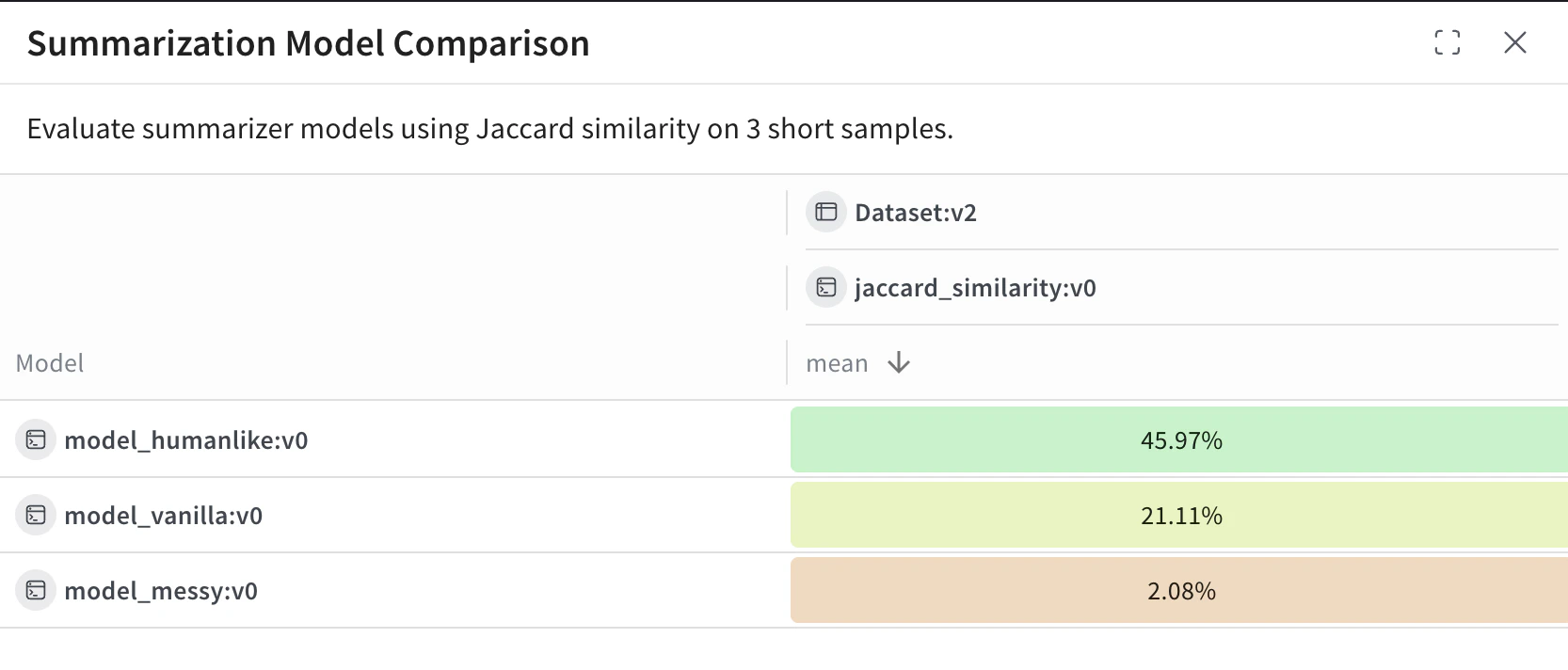
Weave UI의 리더보드
이 예제에서는:
  • model_humanlike가 약 ~46%의 중첩률로 가장 좋은 성능을 보입니다.
  • model_vanilla(단순한 잘라내기 방식)는 약 ~21%를 기록합니다.
  • model_messy는 의도적으로 성능이 나쁘게 만든 모델로, 약 ~2%의 점수를 기록합니다.